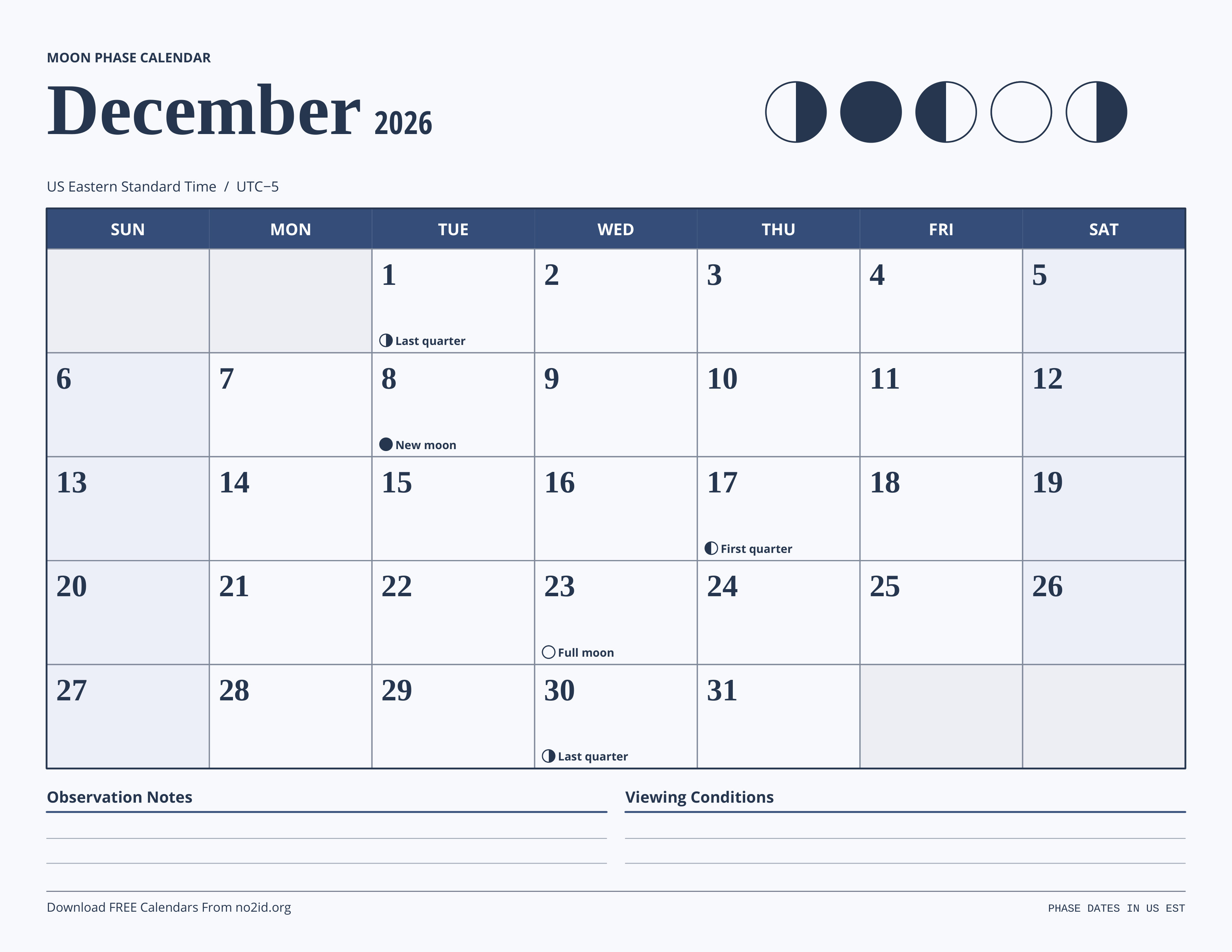
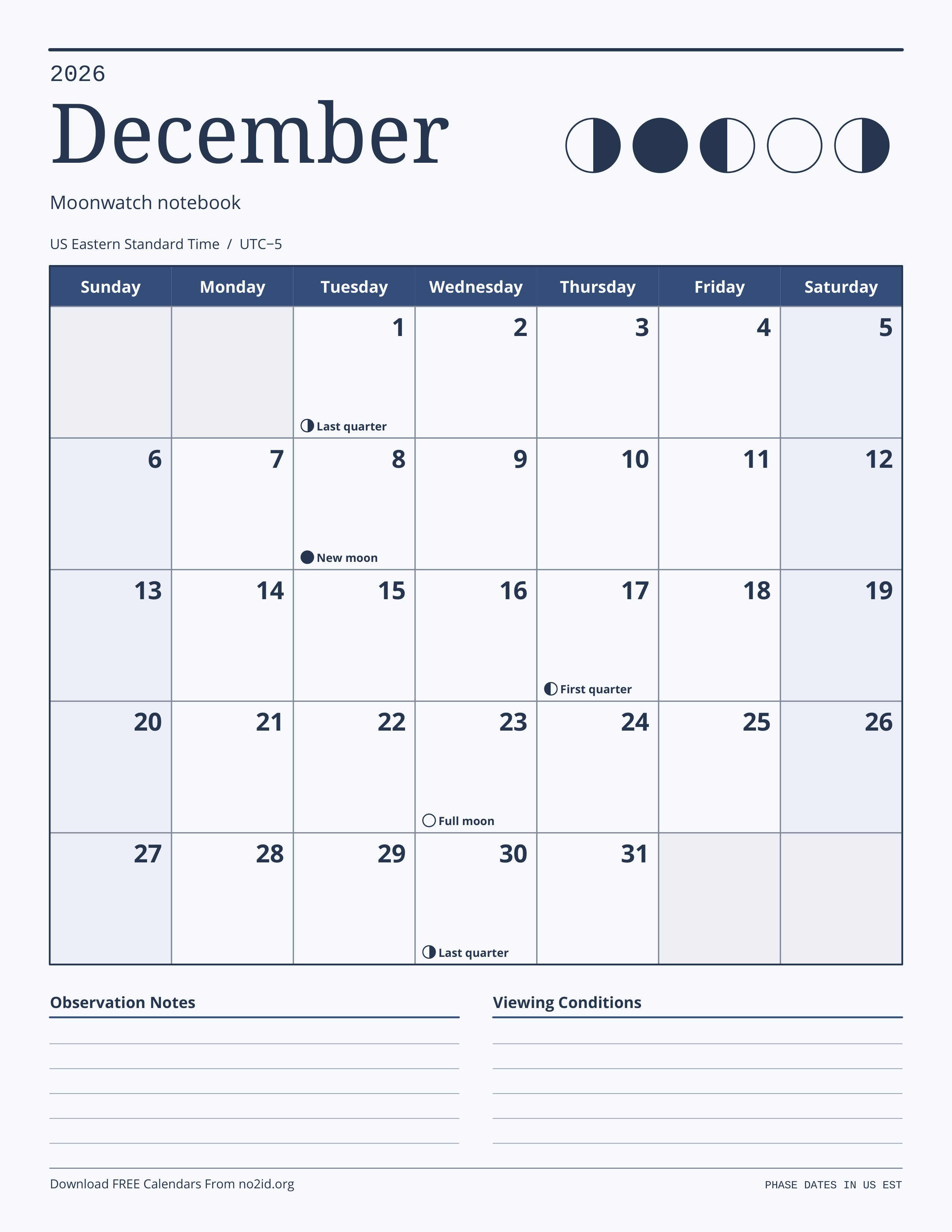
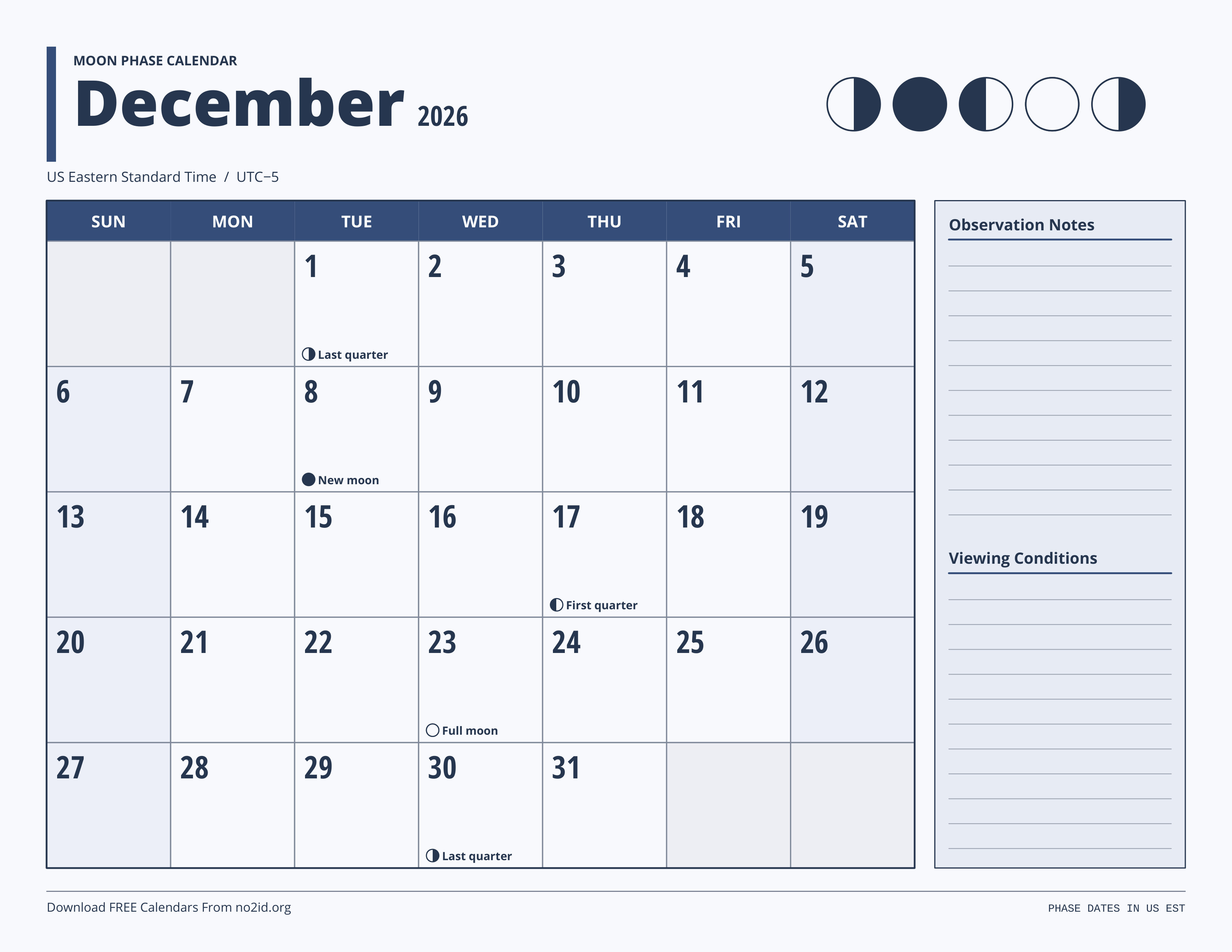
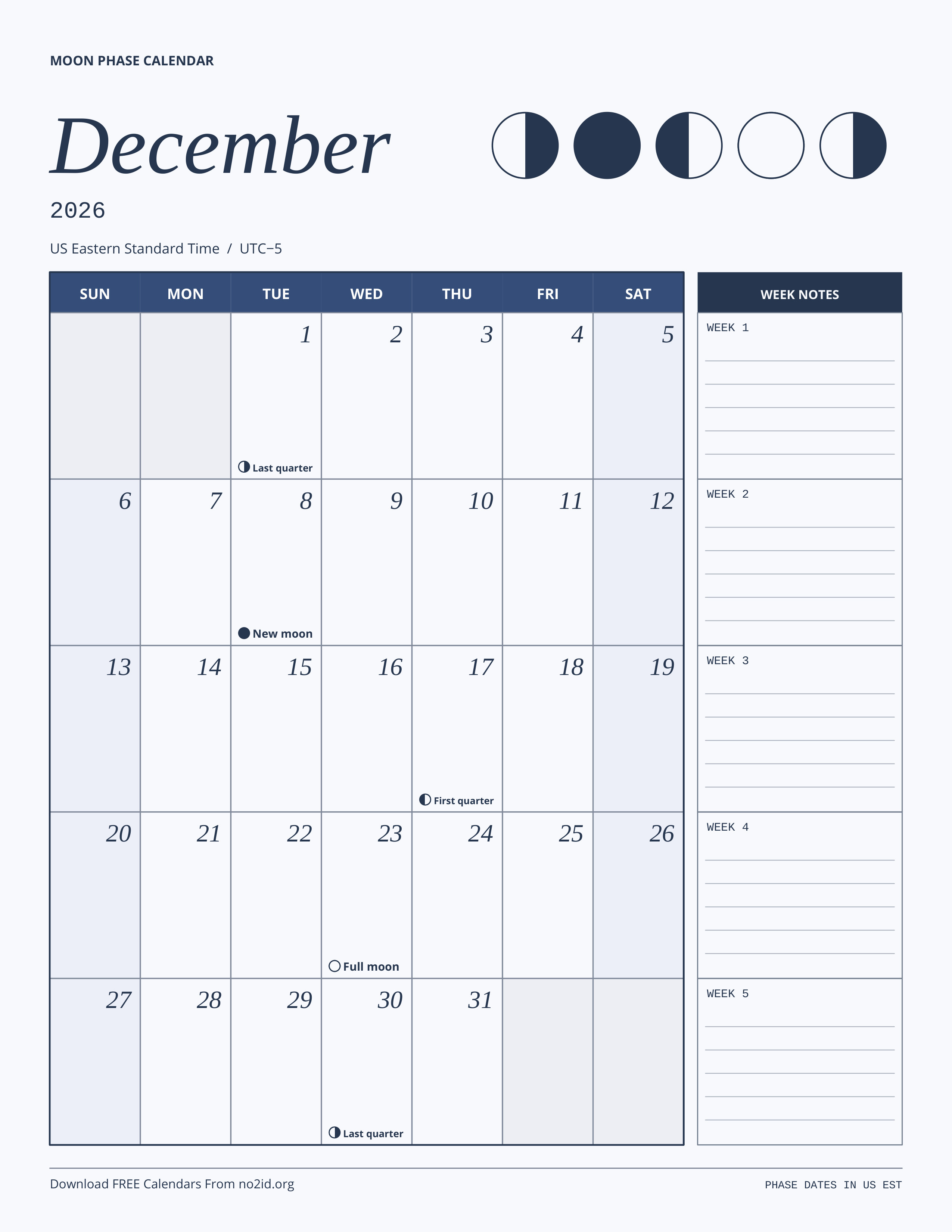
December 2026 Calendar With Moon Phases marks five principal phase dates in US Eastern Standard Time. The last quarter falls on December 1, the new moon on December 8, the first quarter on December 17, the full moon on December 23, and another last quarter on December 30. Use the grid to plan a short observation or compare notes from different nights. Check a moonrise and moonset listing for your town when you need to know whether the Moon will be above your horizon at a particular hour.
December 2026 Calendar With Moon Phases: Lunar Dates Guide
Read a December 2026 Calendar With Moon Phases Across Time Zones
| Phase | US Eastern date | US Pacific date | UTC date |
|---|---|---|---|
| Last quarter | Tue, Dec 1 | Mon, Nov 30 | Tue, Dec 1 |
| New moon | Tue, Dec 8 | Tue, Dec 8 | Wed, Dec 9 |
| First quarter | Thu, Dec 17 | Wed, Dec 16 | Thu, Dec 17 |
| Full moon | Wed, Dec 23 | Wed, Dec 23 | Thu, Dec 24 |
| Last quarter | Wed, Dec 30 | Wed, Dec 30 | Wed, Dec 30 |
The opening last quarter illustrates how to read a December 2026 calendar with moon phases in a different time zone. At the instant of that phase, the clock in New York has passed midnight and the date is already December 1. In Los Angeles it is still November 30. A Pacific calendar can therefore leave that event off a December-only grid, while the Eastern calendar includes it in the very first box. Both record the same event. The December 17 first quarter creates another previous-evening date on the West Coast.
The full moon offers the opposite comparison with a world time reference. It falls during the evening of December 23 in the Eastern United States. Universal Time has already advanced to December 24. Before comparing a wall calendar with an astronomy table, find the time zone printed on each. The astronomical event takes place at one instant even though several local civil dates may describe it.
What a Phase Date Tells You
The Moon reflects sunlight. As it orbits Earth, we see a changing portion of its sunlit half. At first and last quarter, roughly half of the disk facing us looks bright. “Quarter” describes the position in the cycle. At full moon the visible face looks rounded and bright. At new moon the sunlit half faces mostly away from Earth and the Moon is generally difficult to see. Ordinary phases follow this changing geometry as the Moon travels around Earth.
- Waxing means the sunlit portion we see is increasing. Look for a growing crescent between new moon and first quarter.
- Waning means that visible portion is decreasing. Following full moon, the illuminated part gradually narrows.
- Gibbous describes a disk that appears more than half illuminated but short of completely full.
- A crescent shows less than half the disk illuminated. Sketch its apparent tilt as you see it instead of assuming it must sit upright.
Use a December 2026 Calendar With Moon Phases for a Sky Journal
Start with a window or an open spot that offers a recognizable landmark. Note the direction or describe the landmark in plain words so you can compare future observations. Write down your local date and time before drawing. A clock reading and a simple note about cloud cover make even an unsuccessful observation useful. Another person can distinguish “clouds covered the sky” from “the Moon had already set” without having to guess what happened.
- Pick an observation goal, such as comparing the evening crescent with the Moon near first quarter. Find dates for both stages on the grid.
- Check local rise and set times for the chosen dates. Pick a time when the Moon should be above your horizon and the selected spot is accessible.
- Make a small circle on a separate journal page and shade the part that looked dark. Add one landmark and describe the weather in a few words.
- Return on a later date and compare the drawings. Look for a change in the illuminated portion and note whether you observed from the same place and at a similar hour.
Suppose two friends in different states share their sketches after the first quarter. One drawing is labeled Wednesday night and the other Thursday morning. Before assuming one person chose the wrong box, ask each to include the local time zone. Also check whether each observed at the exact phase or simply on a nearby evening. A person viewing the Moon a few hours away from a principal phase can still see a shape close to the one drawn in the calendar.
Plan Around Evening and Morning Visibility
A waxing crescent often suits an after-dinner observation when it is still up after sunset. Around last quarter, early morning can be a more promising choice. The time of the phase is separate from the time the Moon rises over your part of the world. Buildings, trees, hills, and clouds can all affect the view you actually get. If the horizon is blocked, record that fact rather than treating a blank sketch as a failed entry.
Why December Has Two Last Quarters
A phase cycle from one new moon to the next averages about 29½ days. December has 31 days, and this month’s first last quarter lands near the beginning of the calendar in Eastern time. That gives a December 2026 calendar with moon phases room to show the same quarter again before the 31st. You can trace the sequence from December 1 through new moon, first quarter, and full moon, then reach last quarter once more on the 30th. The repeated name makes sense when you follow the cycle across the page.
For a child comparing the two quarter phases, keep both sketches in the same notebook and add the observation time underneath. It makes a difference whether one drawing was made from the kitchen before breakfast and the other from a friend’s porch before bedtime. The setting can become part of the record alongside the shape.
Keep the December 2026 calendar printable for ordinary appointments. Use the month-at-a-glance date reference to check a weekday and the calendar with notes for a separate log of what you saw outdoors.
1 thought on “December 2026 Calendar With Moon Phases and Lunar Dates”