October to December 2026 Calendar shows the fourth quarter of 2026 on one sheet. October, November, and December contain 92 days altogether, long enough for a small team to propose an event, book a space, run it, and return the borrowed equipment. The quarter view lets you see which parts have to happen in sequence. Use it for decisions with consequences across several weeks, and keep the daily details in whatever system your team already opens every day.
October November December 2026 Calendar: Free Printable
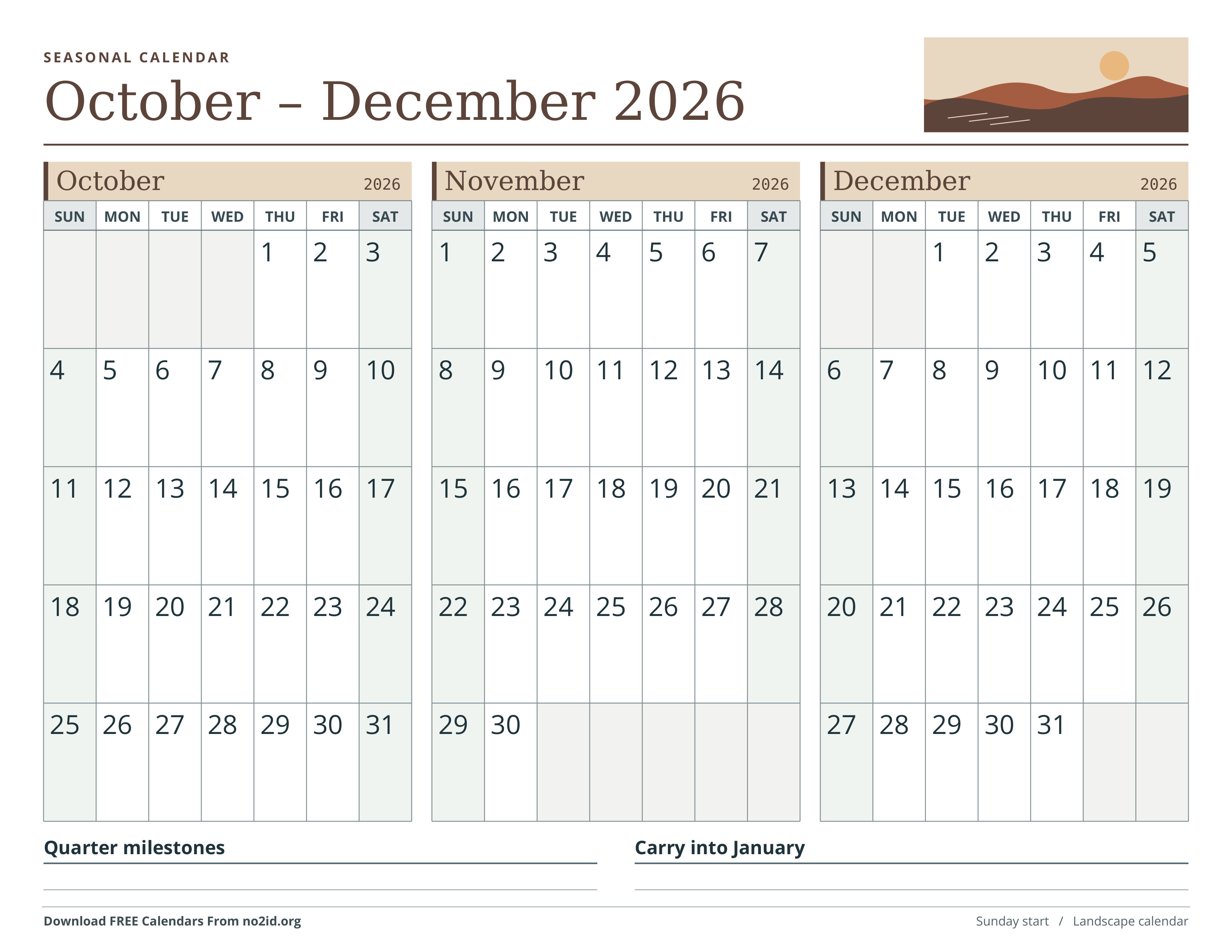
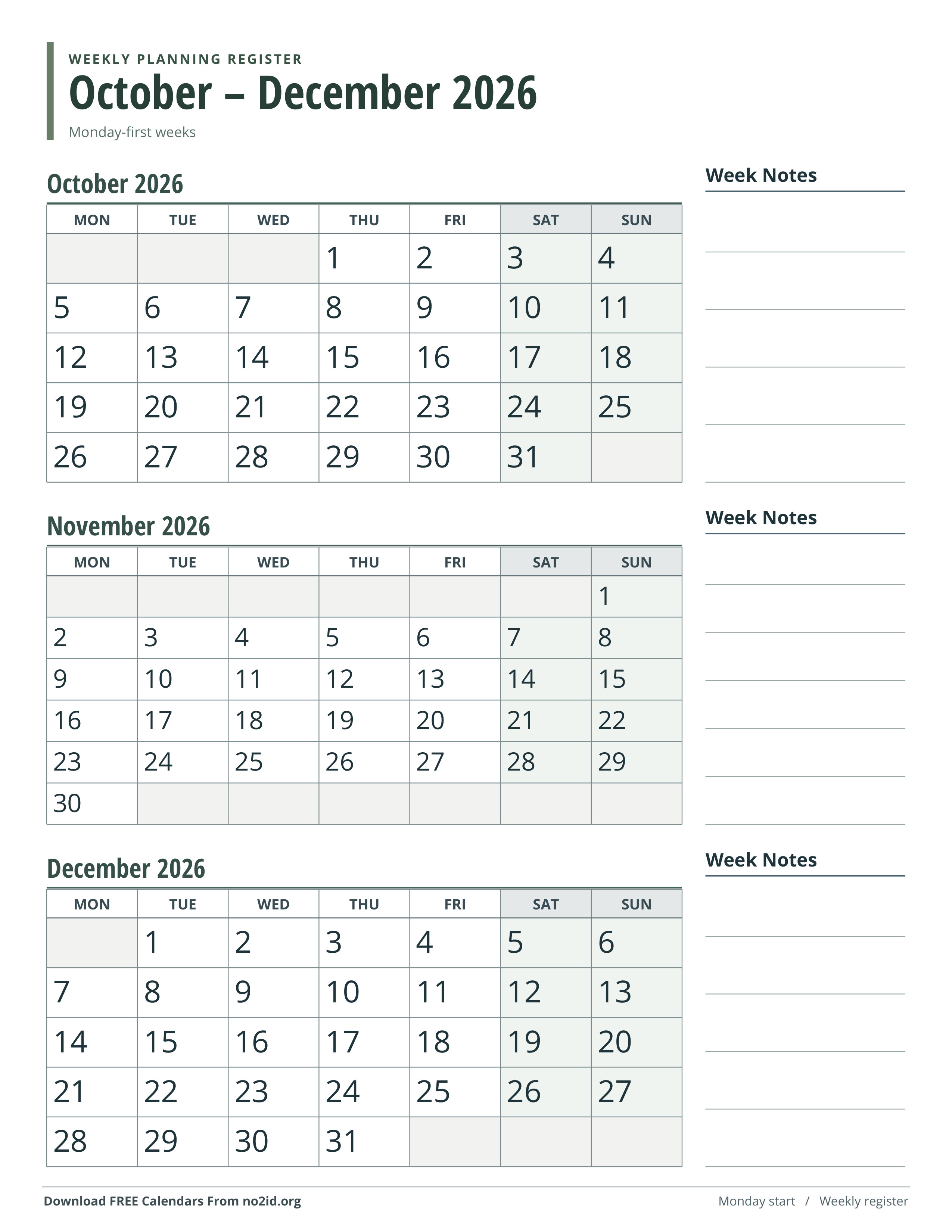
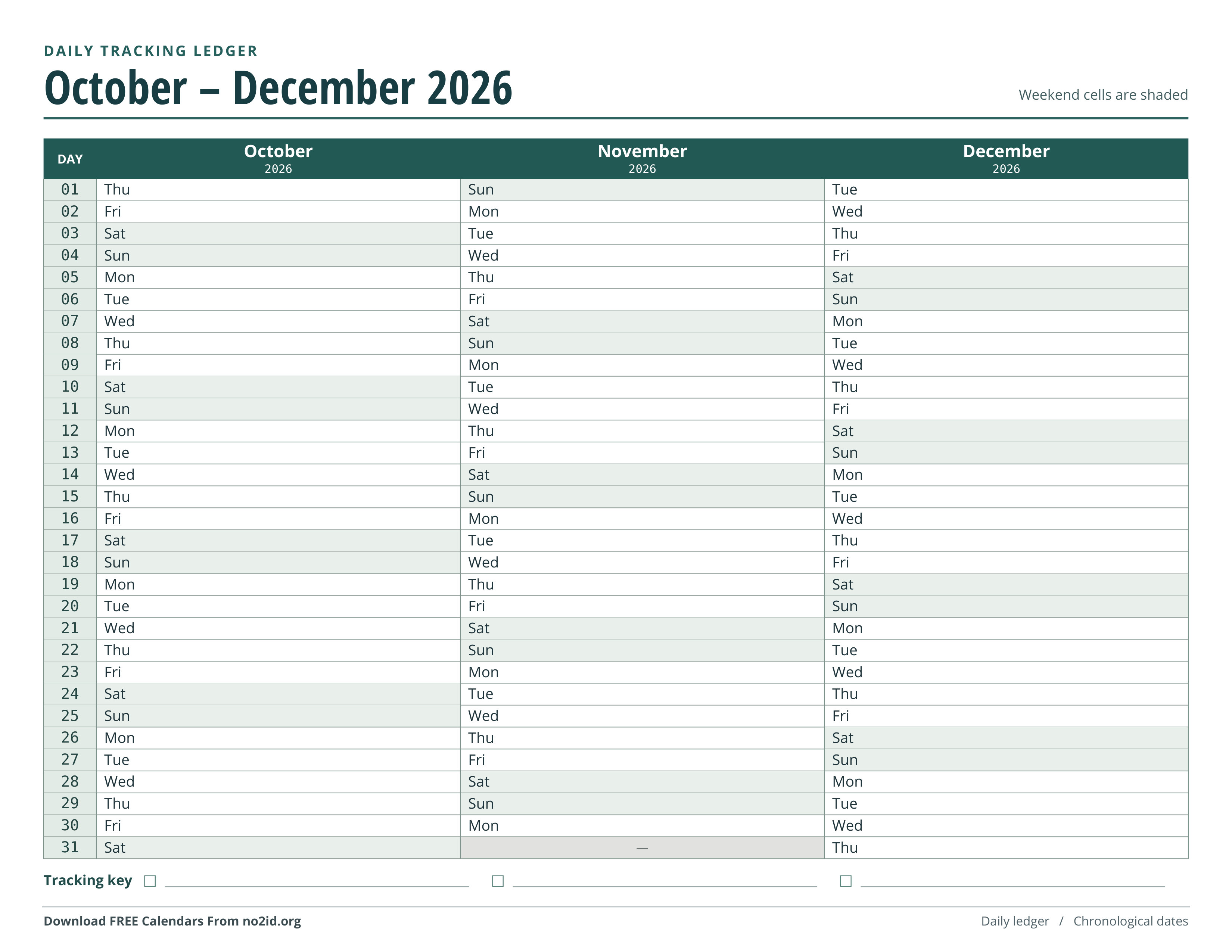
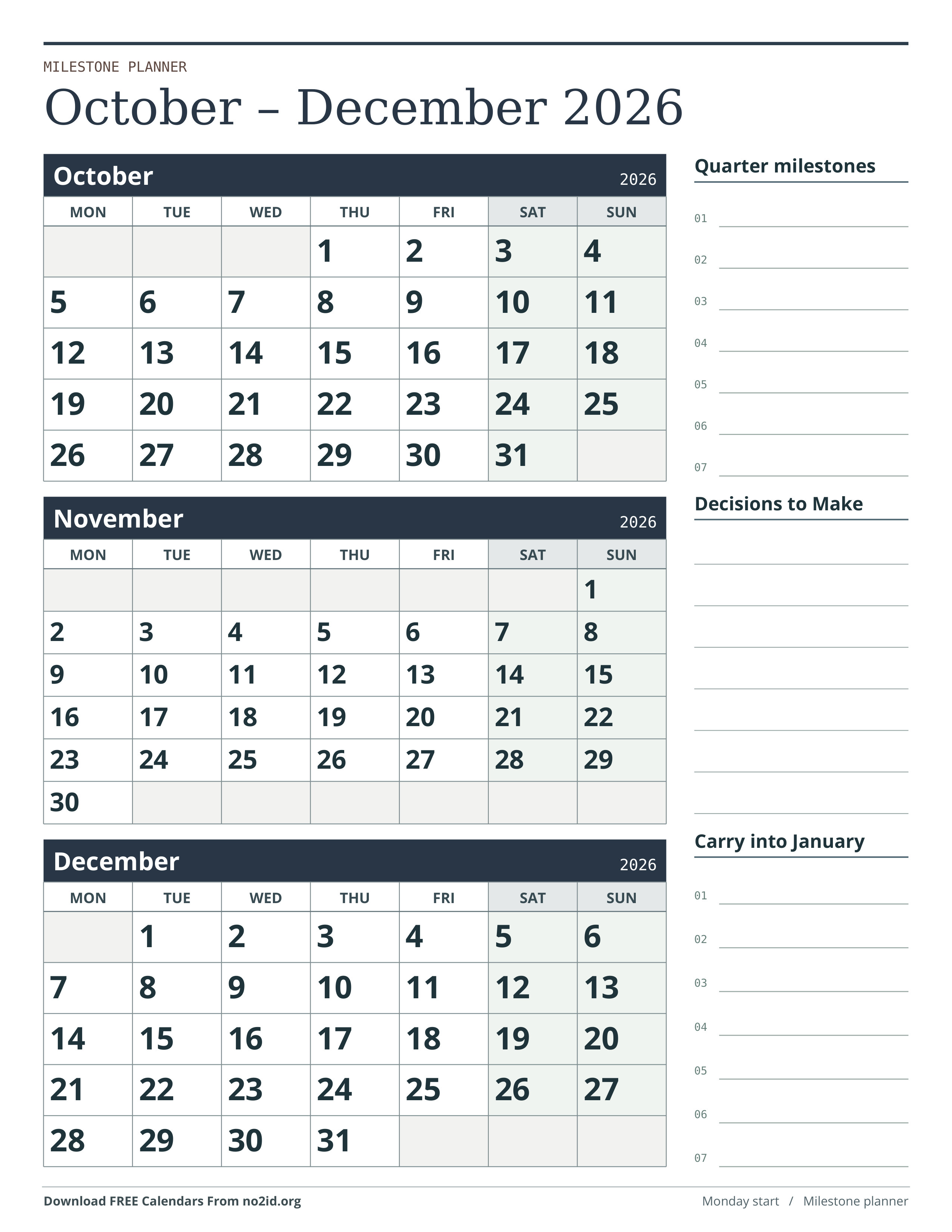
Choose an October to December 2026 Calendar for Your Team
The three-month grid is the simplest place to mark an event with a definite date. A layout with a milestone area also leaves room for decisions the group has to reach within the quarter, even when a precise day has yet to be agreed. Use the full-size image for a meeting handout. The normal browser print command may include the rest of the article as well.
Give Each Month a Specific Job
Picture a neighborhood group building a winter book swap. In October the group needs a room and someone willing to run the event. In November it needs an estimate of the number of tables, boxes, and volunteers. In December it needs a load-in time and a plan for books left behind. Writing “book swap” in three different months barely helps. Writing the decision due in each month tells volunteers where their attention belongs.
October begins on Thursday and ends on Saturday. November opens on Sunday and ends on Monday. December begins on Tuesday and closes on Thursday. These boundaries matter when you plan in full weeks. A team that meets on Mondays will have an opportunity to meet on November 30, just before December begins. A team that meets on Thursdays sees its final October meeting on October 29, two days before the end of that month. Use the weekdays your people actually share.
| Quarter Stage | Example Checkpoint | What You Can Decide |
|---|---|---|
| October | Room reservation received | Whether to announce a date |
| November | Table and volunteer counts confirmed | Whether to cap donations |
| Early December | Setup instructions sent | When people should arrive |
| Late December | Unclaimed boxes collected | When the room can be released |
Find the Decision That Can Move Everything Else
Start with the item that has the widest effect. For a community event it may be access to the building. A room offered “sometime in December” does not settle whether the advertised date will work. Give the volunteer contacting the building a reply date in October. Mark the proposed event in pencil. When written confirmation arrives, ink the date and release the remaining tasks that depended on it. That single change tells the rest of the group when it can book or buy things.
Avoid filling the early weeks with tasks that can be done only after a decision. Printing posters before the venue confirms the room, for example, makes a busy calendar look productive while increasing the chance of wasted work. Put “approve poster” on the calendar and leave design revisions in the working document. Once the approval date has an owner, the designer can plan the smaller steps without asking everyone else to track them.
Schedule Backward From the Public Date
- Place the event, delivery, or presentation on its fixed date and write the name of the person who can change it. That name helps resolve a conflict quickly.
- Identify the last prerequisite. If the team needs a room layout before setting up, give that layout an approval date while the custodian is working.
- Continue backward until you reach a task you can start now. A gap between two checkpoints is fine when a supplier or partner needs time to respond.
- Check the dates with the people doing the work. A three-week interval on paper may contain only two days when a part-time volunteer is available.
Read Thanksgiving Week Separately
In the United States, Thanksgiving falls on Thursday, November 26, in 2026. Your team members, printer, building office, and transportation provider may keep different schedules that week. Ask each person whose availability affects the plan and mark confirmed closures or absences. If an approval is still waiting on the evening of Wednesday, November 25, seeing the surrounding week on the same sheet will help you choose a realistic date to follow up.
- Use a box around a public-facing date that has already appeared on a flyer or registration form.
- Mark a small question mark next to a booking that somebody requested but nobody has accepted.
- Give borrowed items a return date as soon as you record their pickup dates.
- Reserve one spot for the day when the organizer will decide whether to reduce the scope if help is short.
Use the October to December 2026 Calendar During Meetings
Print a copy large enough to make a short note in each month, then let one person maintain the shared version. Ask each volunteer for their next dated commitment. If someone starts reading a long to-do list, capture only the action likely to affect another person. A promised number of tables belongs on the sheet because someone else must arrange transportation. Comparing two possible poster fonts can stay off the agenda until a designer needs an approval.
The same sheet can help after the event if your October plans changed. For each checkpoint you moved, record the date it actually happened beside the planned date. A delay getting into the building points to a different fix than a shortage of drivers. At the final December meeting, ask which October decision deserved more time and which November check genuinely saved trouble. Those answers leave the next organizer with something more instructive than a clean quarterly grid and a box of leftover books.
The free printable December 2026 calendar provides space for final-month tasks. Narrow the review to the November–December calendar, or widen it by one month with the September–December calendar.
1 thought on “October to December 2026 Calendar for the Fourth Quarter”