Monday Start December 2026 Calendar pages put the workweek on the left and the weekend together on the right. December begins on Tuesday, so the first numbered box sits in the second column of the top week. Saturday, December 5, and Sunday, December 6, finish that row. This arrangement works well when you plan a class, assign shifts, or divide chores from Monday through Sunday and want to see an entire weekend without jumping to the next line.
Read a Monday Start December 2026 Calendar
If you usually read a Sunday-first calendar, check the weekday header before writing the first appointment. A position that feels like Tuesday on one layout can represent Wednesday on another. Trace down from the header until you reach the number you need. For a quick check in December 2026, the first complete Monday-to-Sunday row begins on the 7th and finishes on the 13th.
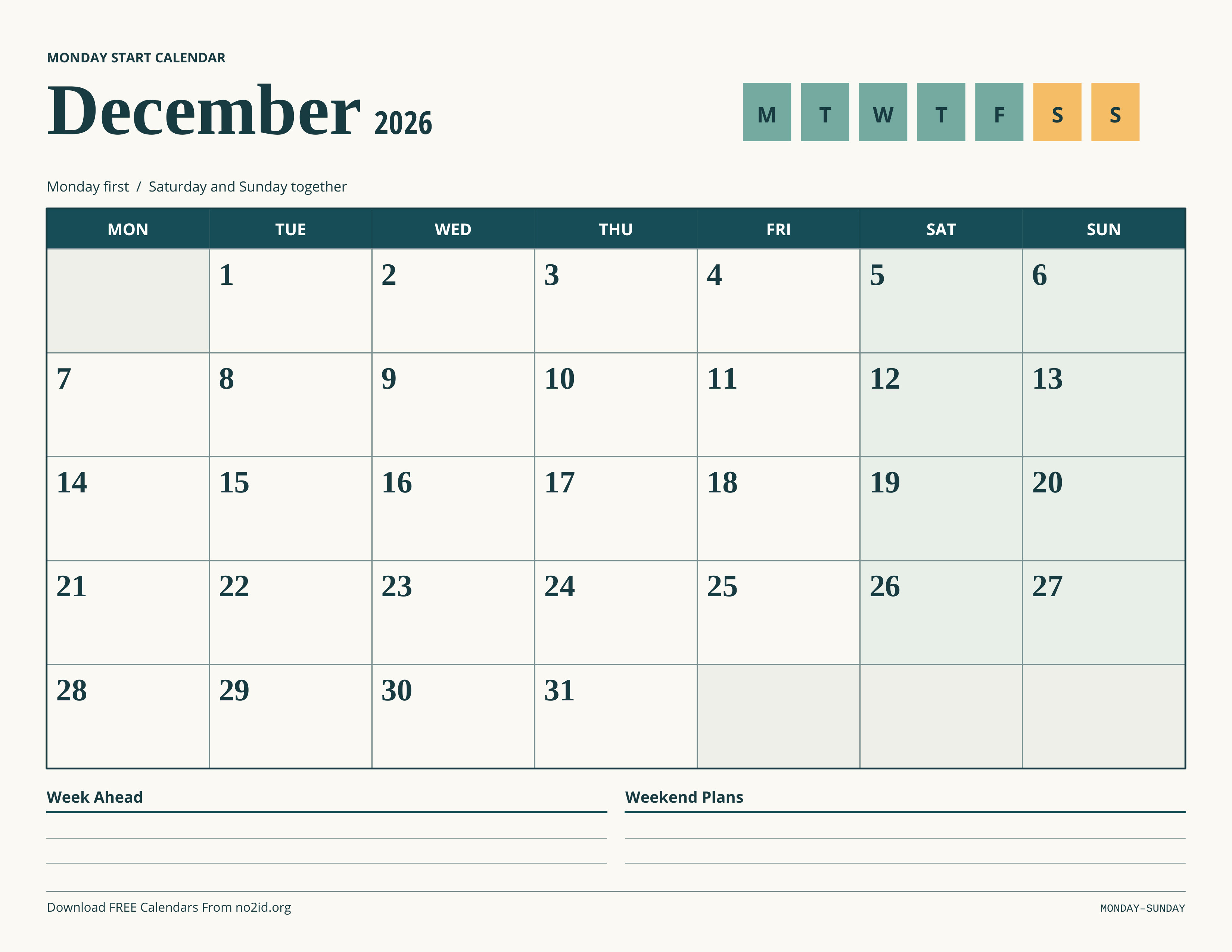
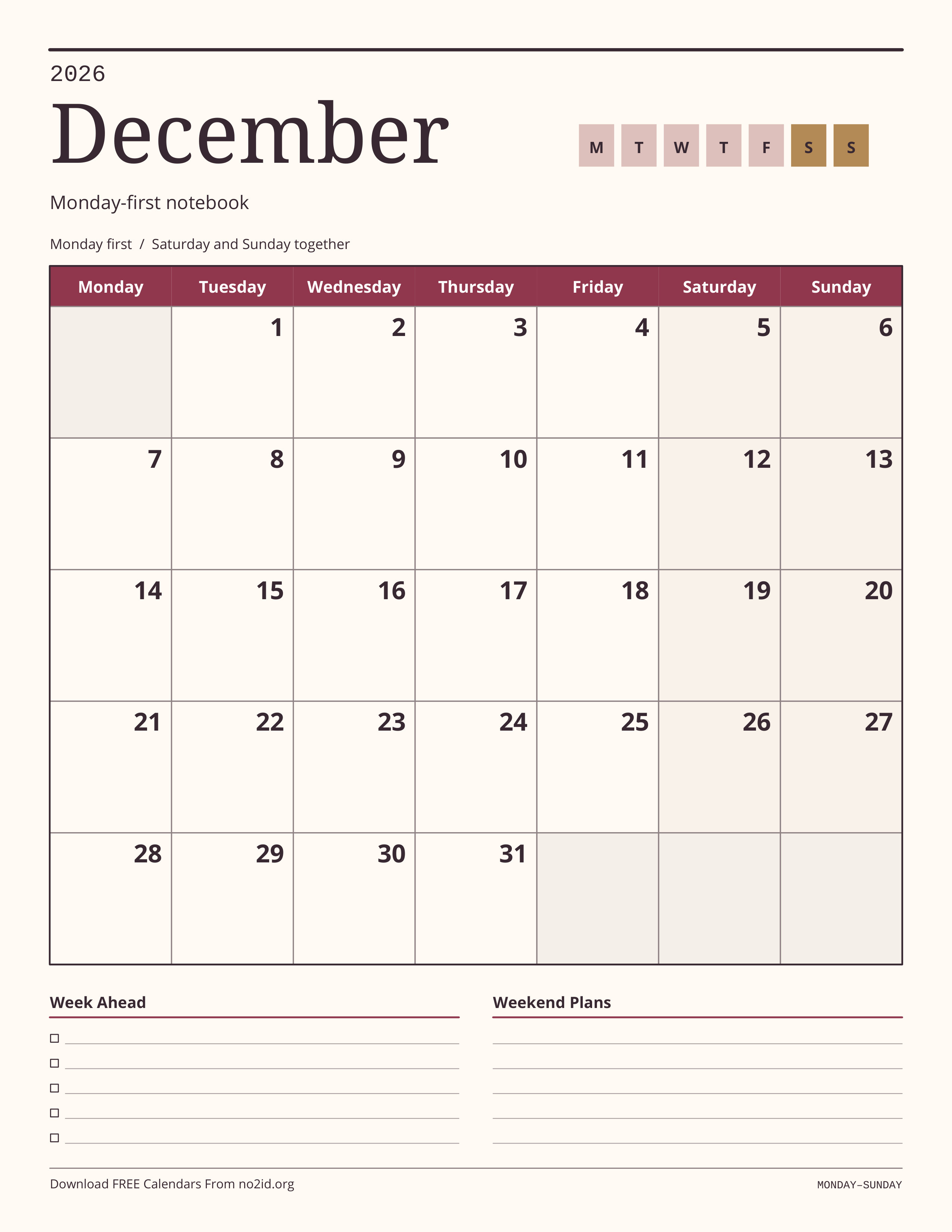
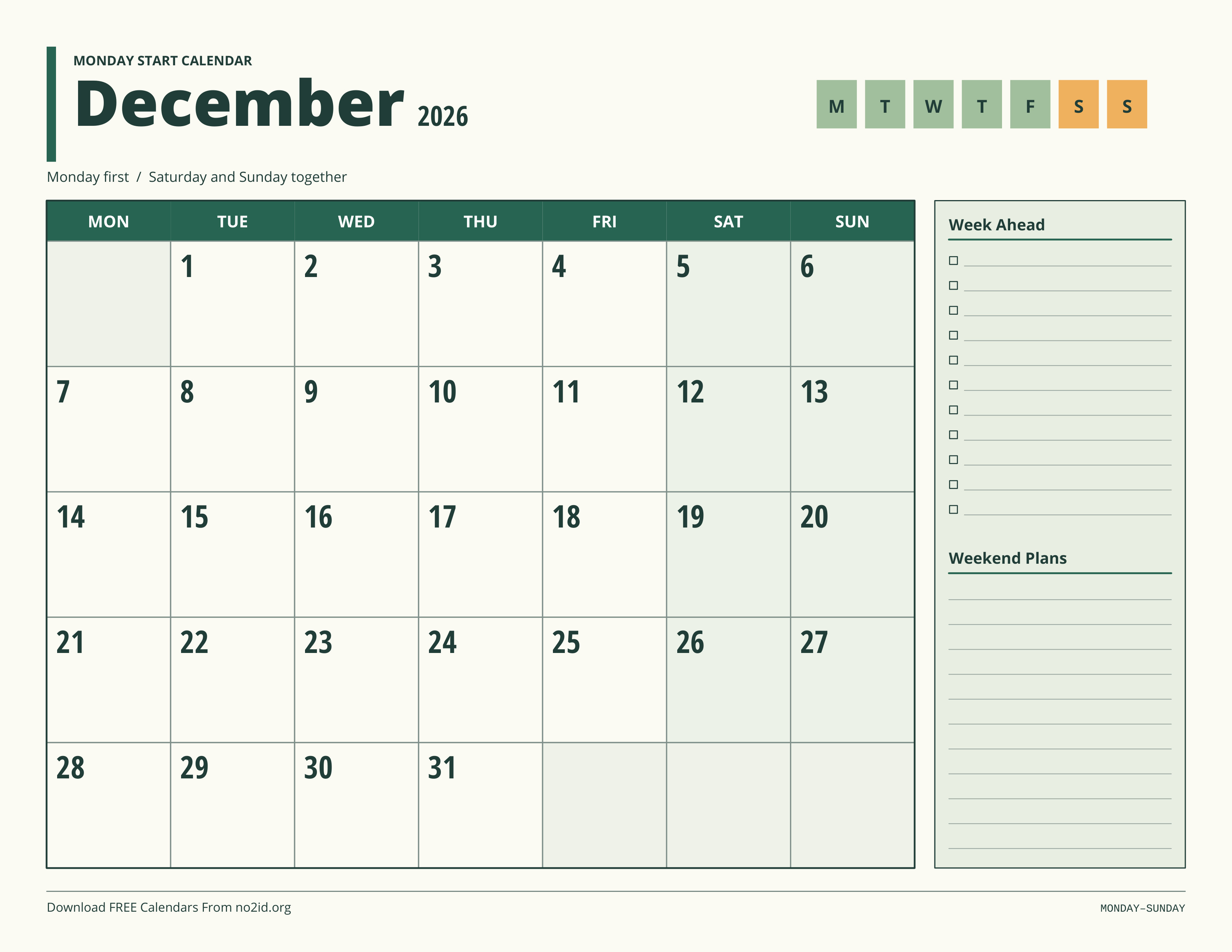
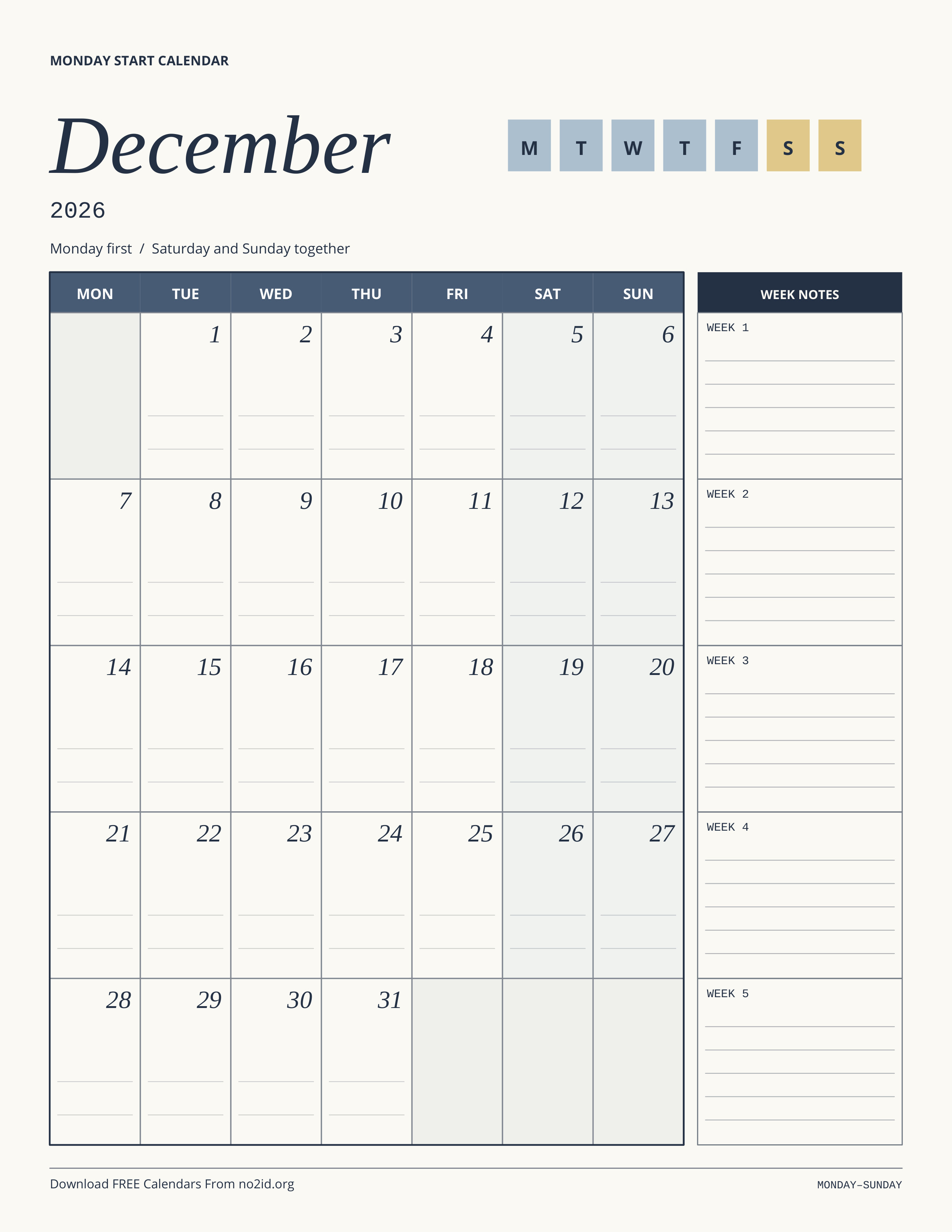
| Calendar Row | December Dates in That Row | Weekend Dates |
|---|---|---|
| Opening week | Tuesday 1 through Sunday 6 | 5 and 6 |
| First complete week | Monday 7 through Sunday 13 | 12 and 13 |
| Second complete week | Monday 14 through Sunday 20 | 19 and 20 |
| Third complete week | Monday 21 through Sunday 27 | 26 and 27 |
| Closing week | Monday 28 through Thursday 31 | January 2 and 3 |
Plan One Row at a Time
Start with Monday morning and ask what must be true by Sunday evening. At a community theater, a director might want costumes labeled before Saturday’s dress rehearsal. On the week beginning Monday, December 7, write “labels ready” on Friday the 11th, then assign measuring, sewing, and checking to earlier days. The rehearsal and the work leading up to it appear together, which makes an unrealistic turnaround easier to spot.
- Circle the commitment with the least flexibility, such as a Saturday rehearsal or a Friday handoff.
- Count back along the same row to identify the last practical working day before that commitment.
- Mark each earlier preparation day with a short action and the initial of the person responsible.
- Review the row from left to right and look for places where one person has two jobs at once.
Read Saturday and Sunday as a Pair
Keeping the weekend together is useful for two-day events. A tournament that runs December 12 and 13 can take one penciled line across the final two columns. Put the Saturday check-in time at the start of the line and Sunday’s expected pickup time at the end. You can still give each date its own details, such as where a child sleeps on Saturday or which adult brings equipment home.
Weekends can also carry different obligations. If Saturday is for an outing and Sunday is the day everyone prepares for school, seeing them side by side helps protect the time needed for both. Try writing the return time underneath a Saturday trip. A late return can change how much of Sunday is available for laundry, packing, or checking school materials.
Transfer Dates to Your Monday Start December 2026 Calendar
Copy the weekday and date together when another schedule begins on Sunday. A reminder that says “third box in the second row” is unreliable. “Wednesday, December 9” works on both layouts. This matters when moving a handwritten roster to your phone, copying an instructor’s class dates, or matching a custody schedule to the calendar displayed at home.
- Read the number aloud with its weekday before transferring an appointment.
- For weekly appointments, enter the first instance and count forward seven days to check the next one.
- Write the actual exception to a repeating schedule in the box where it occurs.
- For an overnight commitment, include the following morning’s return time in the next date box.
If you save the file as Free Printable December 2026 Calendar Monday Start, someone browsing the shared folder can tell how the weeks run before opening the sheet. On the printed copy, point out the Monday column to anyone who is accustomed to finding Sunday there. A volunteer who records an evening shift in the wrong column could arrive a day early, even after reading the correct week. A quick look at the first row is enough to settle the orientation.
If you compare two weekly totals, check how many December days appear in each row. The opening row contains six December dates, while the closing row contains only four. A tally of practice sessions that is lower in the last row might simply reflect the end of the month. Include the January portion when your question concerns a whole calendar week, or label the tally “December only” when that is the period you intend to measure.
Close the Week That Continues Into January
Monday, December 28, starts a week shared with the next month. Thursday the 31st is the final December date. If your weekly review takes place on Sunday, you will finish this particular week on January 3, 2027. Keep January’s page nearby when assigning the Friday, Saturday, and Sunday portions of that week. Enter a cross-month commitment on both pages with the correct dates.
A workgroup can handle this transition by writing a short handoff on Thursday. Who owns the open task? What is the next scheduled date? Where will the group find the January sheet? A note such as “Maya has keys, return Mon Jan 4” gives the next reader a person, an action, and a date. It also leaves the final row readable when several plans continue past December.
When you place the finished sheet in a binder, keep it next to your normal weekly planner. Check that both display the same weekday order. You can then turn a monthly commitment into a specific appointment without mentally moving Sunday from one edge of the week to the other.
Use the December 2026 calendar printable for a conventional month view. Keep shift notes on the calendar with notes, or see how a working week crosses the new year on the December–January calendar.